
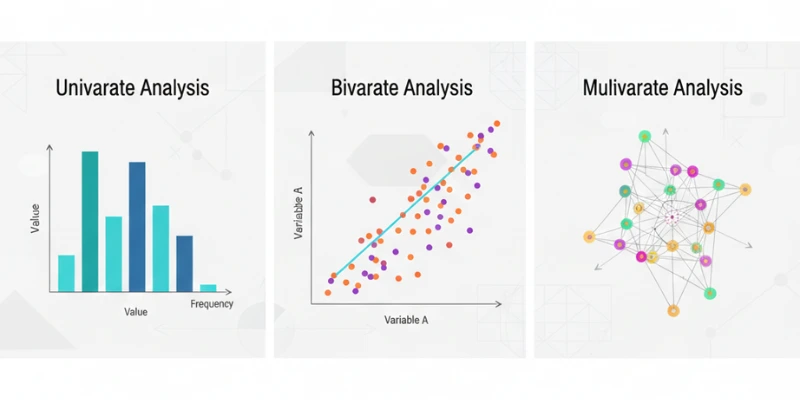
Understanding data begins with knowing how many variables you are analyzing at a time. Univariate, bivariate, and multivariate analysis are the core methods used in data science to explore data and uncover patterns. Every method has a distinct objective and assists analysts in obtaining insights with growing levels of complexity. Learning these concepts builds a strong foundation for effective data analysis and decision making. For those looking to gain hands-on experience, enrolling in a Data Science Course in Trivandrum at FITA Academy can provide practical training and expert guidance to strengthen these essential skills.
What is Univariate Analysis
Univariate analysis focuses on examining a single variable at a time. The primary objective is to comprehend the distribution, average, and variability of that variable. This type of analysis answers simple but important questions about the data. It helps identify common values, extreme values, and overall patterns.
Statistics like mean, median, mode, and standard deviation are frequently utilized in univariate analysis. Visual tools like histograms and box plots are also popular for summarizing data. Univariate analysis is often the first step in data exploration because it provides a clear picture of individual variables before moving to more complex analysis.
What is Bivariate Analysis
Bivariate analysis involves studying the relationship between two variables. The purpose is to understand how one variable changes in relation to another. This type of analysis helps identify associations, trends, and possible dependencies between variables. Anyone interested in gaining practical experience, joining a Data Science Course in Kochi can provide hands-on training and expert guidance to better understand these relationships.
Common examples include comparing height and weight or studying the relationship between study time and exam scores. Scatter plots, correlation values, and simple comparisons are often used in bivariate analysis. This approach helps analysts move beyond isolated variables and begin understanding interactions within the data.
What is Multivariate Analysis
Multivariate analysis examines three or more variables at the same time. It allows analysts to understand complex relationships and interactions that cannot be captured through simpler methods. This type of analysis is especially useful when real world problems involve multiple influencing factors.
Techniques such as clustering, dimensionality reduction, and multiple variable comparisons are part of multivariate analysis. These methods help identify patterns, groupings, and hidden structures in data. Multivariate analysis plays a critical role in predictive modeling and advanced data science applications. For those looking to gain hands-on experience, taking a Data Science Course in Jaipur can provide practical training and expert guidance to master these advanced techniques.
Key Differences Between the Three Approaches
The main difference between univariate, bivariate, and multivariate analysis lies in the number of variables involved. Univariate analysis focuses on one variable, bivariate analysis focuses on two variables, and multivariate analysis focuses on three or more variables. As the number of variables increases, the depth and complexity of insights also increase.
Each method builds upon the previous one and serves a specific purpose. Univariate analysis helps understand individual features. Bivariate analysis helps explore relationships. Multivariate analysis helps explain real world complexity.
Many readers exploring data analysis also seek ways to enhance their overall learning. For instance, joining a B School in Chennai can offer valuable exposure to business concepts and management skills that complement technical expertise in data analysis.
Why These Analyses Matter in Data Science
Univariate, bivariate, and multivariate analysis form the backbone of exploratory data analysis. They help data scientists clean data, select relevant features, and avoid incorrect assumptions. These techniques also support better model building and more accurate conclusions.
By mastering these approaches, analysts can move from simple observations to meaningful insights. Understanding when and how to use each type of analysis is a critical skill for anyone working with data.
Also check: Model Interpretability and Explainable AI (XAI)